
Rent-to-Own Cars vs. Lease-to-Own: Which Car Ownership Plan is Right for You?
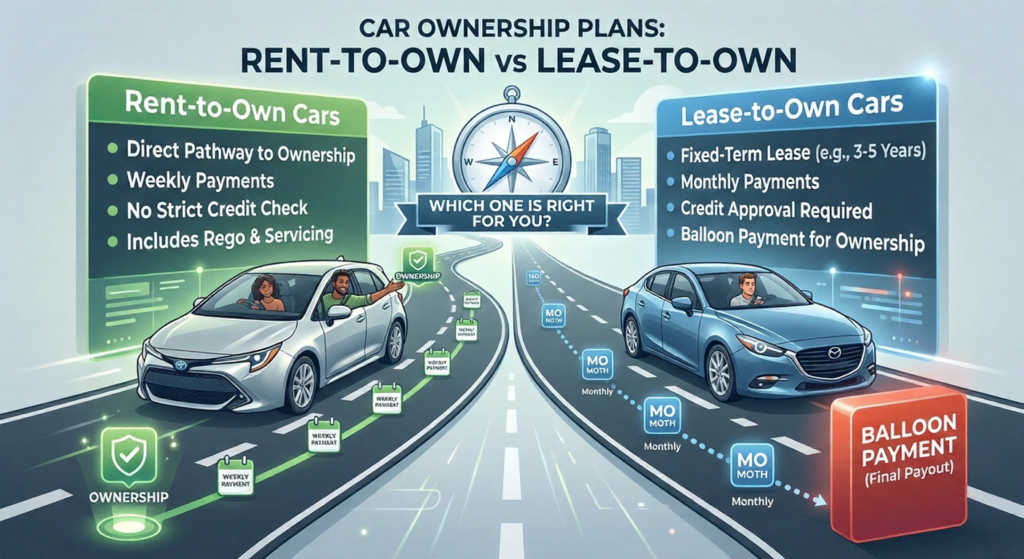
Rent-to-own and lease-to-own both reduce upfront costs compared to buying outright – but they work very differently. Rent-to-own cars is designed as a direct pathway to ownership, using structured weekly payments and requiring no strict credit checks. Conversely, lease-to-own is a fixed-term agreement that usually requires credit approval and may involve a final balloon payment before ownership transfers.
For Perth drivers with bad credit, no credit history, or urgent work needs, this difference is critical. One option prioritises accessibility and flexibility; the other prioritises structured finance and lower monthly payments.
In this guide, you’ll learn exactly how rent-to-own cars compare to lease-to-own, so you can choose the smartest car ownership plan with confidence.
Keep reading before you commit to any agreement.
What Is Rent-to-Own?
Rent-to-own is a flexible car ownership plan that lets you drive a car now while working toward ownership over time. It doesn’t require any traditional bank loan or large lump sum upfront payment. Instead of buying a car outright or taking out a loan, you sign a contract with a rent-to-own provider and make fixed weekly payments that cover both the use of the car and contributions toward eventual ownership. Once you’ve completed all agreed payments, the car becomes yours.
How Rent-to-Own Cars Work
Rent-to-own car agreements operate on a simple premise: you make regular, affordable payments to a provider while you use the vehicle, and after the payment term ends, you become the owner.
Here’s how it works:
- Choose your car: Pick a reliable vehicle from the provider’s available fleet.
- Apply and get approved: Many providers assess income instead of credit score, making this option accessible even with poor or limited credit.
- Sign the rent-to-own agreement: You agree to a schedule of weekly payments that include not just the vehicle use but contributions toward eventual ownership.
- Make routine payments: Consistent weekly payments keep you on track toward ownership.
- Ownership transfer: Once all payments are complete according to the contract terms, you own the car outright.
This process removes many traditional barriers like big deposits or strict credit checks, while still giving you a path to ownership that’s straightforward and predictable. If you’re interested in how you can get started with zero upfront cost, check out our ultimate guide to rent-to-own cars with no deposit for Perth drivers.
Let’s look closer at what makes rent-to-own cars unique.
Key Features of Rent-to-Own Vehicles
Here are the defining elements of rent-to-own car plans that make them stand out:
→ Ownership Transfer at Term Completion: Ownership transfers after all agreed payments are completed.
→ Fixed Weekly Payment Structure: Payments are set weekly for the full contract term.
→ No Traditional Loan Structure: It is not a bank loan; the provider retains ownership until payments are completed.
→ Contract-Based Agreement: The terms outline payment duration, inclusions, repossession conditions, and transfer process.
→ Optional Bundled Inclusions: Some providers include registration, servicing, or insurance within the agreement.
These features define how rent-to-own works mechanically. Now let’s evaluate the real-world advantages and disadvantages.
Pros and Cons of Rent-to-Own Cars
Pros:
✓ Easier Approval for Credit-Challenged Drivers: Approval often focuses on income stability rather than credit score.
✓ Faster Access to a Vehicle: Applications are typically quicker than traditional finance approvals.
✓ Simplified Budgeting: One consistent weekly payment can make expenses easier to manage.
✓ Lower Upfront Barrier: Many agreements require little to no large deposit.
✓ Clear Path to Ownership: Every payment moves you closer to owning the car outright.
Cons
✗ Higher Total Cost Than Traditional Loans: Convenience and accessibility are built into pricing.
✗ Ownership Only After Completion: You do not legally own the vehicle until all payments are finalised.
✗ Strict Payment Discipline Required: Missed payments may result in repossession.
Who Rent-to-Own Cars Suit Best
Rent-to-own cars are best suited for the drivers who have poor or no credit, need a vehicle quickly, or prefer flexible weekly payments instead of traditional finance. This option works well for rideshare drivers, self-employed workers, and people with fluctuating income who want a simple, all-inclusive plan without strict bank approval. Rent-to-own is ideal if you value fast access, lower upfront costs, and a clear pathway to ownership without credit barriers.
For Perth drivers looking for a complete walkthrough of available vehicles, weekly plans and local requirements, explore our detailed rent-to-own cars guide; designed specifically for WA motorists.
Having understood rent-to-own thoroughly, let’s now explore the alternative: lease-to-own cars, including how they work and who they suit.
What is Lease-to-Own Cars?
Lease-to-own cars is a fixed-term vehicle lease that lets you use a car for a set period with the option – or sometimes the obligation – to buy it at the end. Unlike rent-to-own (which is structured around weekly payments and a clear pathway to ownership), lease-to-own agreements behave more like a traditional finance product; you lease the car for the term, make scheduled payments (usually monthly), and then either return, renew, or purchase the vehicle by paying a pre-agreed final sum (often called a balloon or residual payment).
How Lease-to-Own Cars Work
Lease-to-own works through a fixed-term contract where you make monthly payments, meet credit approval requirements, and at the end either return the vehicle or pay a residual (balloon) amount to become the owner. Here’s how:
- Application and credit check: Lenders or leasing companies typically run a credit assessment and verify income before approving a lease agreement. Good or fair credit improves terms.
- Sign a fixed-term lease: You agree to a term (commonly 24–60 months), monthly repayments, and contract conditions (mileage limits, wear-and-tear rules).
- Make regular payments: Monthly instalments cover depreciation and lease fees. Insurance and servicing are often not included unless explicitly bundled.
- End-of-term options: At the lease end you can: return the car, re-lease/renew, or pay the residual/balloon amount to own the vehicle. This final payout is common in hire-purchase and finance-lease structures.
Key Features of Lease-to-Own Car Plans
These are the structural elements that define how lease-to-own agreements work:
→ Fixed-Term Contract (2–5 Years): You commit to a set duration with predetermined payment schedules.
→ Credit-Based Approval Process: Acceptance and terms are determined by credit assessment and financial history.
→ Residual or Balloon Payment Structure: The contract sets a final payout amount if you choose to own the vehicle at the end of the term.
→ Usage Conditions: Agreements commonly include mileage limits and wear-and-tear standards.
→ Defined End-of-Term Options: At contract completion, you may return, renew, refinance, or purchase the vehicle depending on the agreement.
These structural features explain how lease-to-own works. Now let’s look at the practical advantages and trade-offs.
Pros and Cons of Lease-to-Own Vehicles
Pros:
✓ Lower Regular Payments Compared to Full Purchase: Monthly instalments can be lower because you are financing depreciation rather than full value.
✓ Access to Newer Vehicles: Lease-to-own often allows you to drive newer models without a large upfront payment.
✓ Structured Financial Planning: Fixed payments and defined end-of-term options provide predictable budgeting.
Cons:
✗ Strict Credit Requirements: Approval typically requires good or fair credit history.
✗ Large Final Payment Risk: A balloon or residual amount may be required to gain ownership.
✗ Penalty Exposure: Exceeding mileage limits or early termination can increase total costs.
✗ Separate Running Expenses: Insurance, servicing, and maintenance are usually not included in the monthly payment.
Who Lease-to-Own Cars Suit Best
Lease-to-own cars suit drivers with fair to good credit who want predictable monthly payments and access to newer vehicles under a structured 2–5 year contract. It’s ideal for long-term planners who can prepare for a final balloon payment and manage separate running costs like insurance and servicing. Business owners considering hire-purchase or lease structures for tax purposes may also benefit (professional advice recommended).
Now that both models are clearly defined, next we’ll compare rent-to-own vs lease-to-own side-by-side so you can see the nine key differences at a glance.
Rent-to-Own Cars vs Lease-to-Own: 9 Key Differences Explained
When comparing rent-to-own cars vs lease-to-own agreements, the differences go far beyond just weekly or monthly payments. The structure, flexibility, credit requirements and total cost can vary significantly. Here’s a clear, side-by-side breakdown of how each car ownership plan works in real life.
1️⃣ Ownership Structure
Rent to Own a Car:
- You automatically become the owner after completing all agreed payments.
- No large balloon payment at the end in most structured plans.
- Designed as a direct pathway to ownership from day one.
Lease-to-Own:
- You lease the vehicle for a fixed term (often 2–5 years).
- Ownership usually requires a final lump sum (balloon or residual payment).
- Some contracts only give you the option to buy; ownership is not automatic.
Key Difference: Rent-to-own is ownership-focused from the beginning. Lease-to-own requires a final payout or purchase decision before ownership transfers.
2️⃣ Credit Requirements & Approval Process
Rent-to-Own Cars:
- Often no traditional credit check.
- Designed for drivers with poor credit or no credit history.
- Focus is on income stability and affordability.
Lease-to-Own:
- Usually requires a credit assessment similar to traditional finance.
- Approval depends on credit score and repayment history.
- Applications may be declined for low credit profiles.
Key Difference: Rent-to-own is generally more accessible for credit-challenged drivers, while lease-to-own suits those with stronger credit histories.
3️⃣ Upfront Costs & Deposits
Rent to Own Cars:
- Low or no large upfront deposit.
- Weekly payments begin quickly.
- Structured to reduce financial barriers to entry.
Lease-to-Own:
- May require a deposit.
- Establishment and finance fees may apply.
- Additional admin costs can increase the starting expense.
Key Difference: Rent-to-own typically has fewer upfront financial barriers compared to lease-to-own.
4️⃣ Payment Structure & Inclusions
Rent-to-Own a Car:
- Weekly payment plans.
- Often all-inclusive (registration, servicing, insurance may be bundled).
- Designed for simple weekly budgeting.
Lease-to-Own:
- Monthly payments common.
- Insurance and servicing usually separate.
- Balloon payment may apply at the end of the term.
Key Difference: Rent-to-own tends to bundle running costs into one predictable weekly payment. Lease-to-own usually separates these expenses.
5️⃣ Total Cost Over Time
Rent-to-Own Cars:
- Often higher total cost than traditional car loans.
- Pricing reflects accessibility and convenience.
Lease-to-Own:
- May appear cheaper monthly.
- Final balloon payment can significantly increase overall cost.
Key Difference: Lease-to-own may look more affordable upfront but can include a large final payout. Rent-to-own spreads ownership cost evenly across the term.
6️⃣ Flexibility & Commitment
Rent-to-Own Cars:
- Often more flexible agreements.
- Upgrade or exchange pathways may be available.
- Suitable for drivers needing adaptable solutions (e.g., rideshare).
Lease-to-Own:
- Strict 3–5 year commitment common.
- Early termination penalties may apply.
- Less adaptable once contract is signed.
Key Difference: Rent-to-own usually offers more flexibility. Lease-to-own is more contract-bound and structured.
7️⃣ Included Services & Maintenance Responsibility
Rent-to-Own Cars: May include registration (rego), servicing, insurance, and roadside assistance.
Lease-to-Own: Driver typically responsible for insurance, servicing, maintenance, and registration.
Key Difference: Rent-to-own can simplify ownership by bundling ongoing vehicle costs into one payment. Lease-to-own often requires managing these separately.
8️⃣ Risk If Payments Are Missed
Rent-to-Own Cars:
- Missed payments may result in repossession.
- Ownership only transfers after full payment completion.
Lease-to-Own:
- Default can impact credit score.
- Balloon payment obligations may remain enforceable.
Key Difference: Lease-to-own may carry stronger long-term credit consequences, while rent-to-own risk centres around repossession before ownership transfers.
9️⃣ Best Suited For
Rent-to-Own Cars:
- Drivers with bad or no credit
- First-time buyers
- Rideshare drivers in Perth
- Self-employed or casual income earners
- Those needing quick approval
Lease-to-Own:
- Drivers with fair to good credit
- Long-term planners
- Buyers comfortable with final balloon payments
- Those wanting structured monthly budgeting
Rent to Own a Car or Leasing? Quick Comparison
Feature | Rent-to-Own | Lease-to-Own |
Credit Check | No | Yes |
Deposit | Low or None | Required |
Balloon Payment | No | Yes |
Ownership Transfer | After final payment | Option / After final payout |
Inclusions | Often All-Inclusive | Usually, Separate |
Flexibility | Higher | Lower |
Best For | Bad Credit / Fast Approval | Stable Credit Profiles |
Conclusion: Which Car Ownership Plan Is Right for You in Perth?
If you need a vehicle quickly, have experienced loan rejection, or prefer simple weekly payments with fewer credit barriers, rent-to-own cars are the more practical solution in Perth. If you have good credit, want lower monthly payments and can plan for a balloon payment at the end, lease-to-own may suit you better.
Ultimately, the right choice depends on your credit profile, financial stability, and long-term ownership goals. And if flexibility, transparency, and a clear ownership pathway matter most; there’s a smarter way to get behind the wheel.
Ready to stop getting rejected for car loans?
Drive Today & Own Tomorrow with Perth’s Trusted Rent-to-Own Cars Providers
At Sky Global Rentals, we specialise in helping credit-challenged and hardworking Australians get reliable vehicles through flexible, transparent rent-to-own plans. No big deposits. No confusing finance jargon. Just simple weekly payments and a clear path to ownership.
View Rent-to-Own Vehicles – Uber-eligible cars, family SUVs, hybrids, EVs and more.
FAQs
- What is the main difference between rent-to-own and lease-to-own cars?
The main difference between rent-to-own cars and lease-to-own agreements lies in ownership structure and accessibility. Rent-to-own offers a direct path to ownership with flexible weekly payments and minimal credit barriers, while lease-to-own typically requires credit approval and may involve a final balloon payment before ownership transfers.
- Can I get a rent-to-own car with bad credit in Perth?
Yes. Many rent-to-own car providers in Perth assess income and repayment ability rather than credit score. This makes rent-to-own suitable for drivers with poor credit, no credit history, or previous loan rejections.
- Do lease-to-own cars require a credit check?
Yes, most lease-to-own car agreements require a credit assessment similar to traditional car loans. Approval depends on your credit score, income stability, and financial history.
- What happens if I miss a payment on a rent-to-own car?
If you miss a payment on a rent-to-own car, the provider may initiate repossession procedures depending on the contract terms. Because you don’t legally own the vehicle until all payments are complete, consistent payments are essential to avoid losing access to the car.
- What happens if I miss a payment on a lease-to-own agreement?
Missing payments on a lease-to-own contract can impact your credit score and may result in default notices, repossession, or additional fees. If a balloon payment is due at the end of the term, failing to plan for it can also create financial strain.
- How long does it take to own a rent-to-own car?
Ownership timing depends on the contract term. Most rent-to-own car agreements in Australia run between 1 to 5 years. Once all scheduled payments are completed according to the agreement, ownership transfers to you without requiring a final lump sum in most structured plans.
- Is rent-to-own more expensive than a traditional car loan?
In many cases, yes. Rent-to-own cars can have a higher total cost compared to bank car loans because pricing includes accessibility, flexibility, and lower credit barriers. However, for drivers who cannot qualify for a loan, rent-to-own provides a practical path to ownership.
- Is lease-to-own cheaper than rent-to-own?
Lease-to-own can have lower monthly payments, but total cost depends on the balloon payment and contract terms. While lease-to-own may appear cheaper upfront, the final payout and separate maintenance costs can significantly increase overall expen